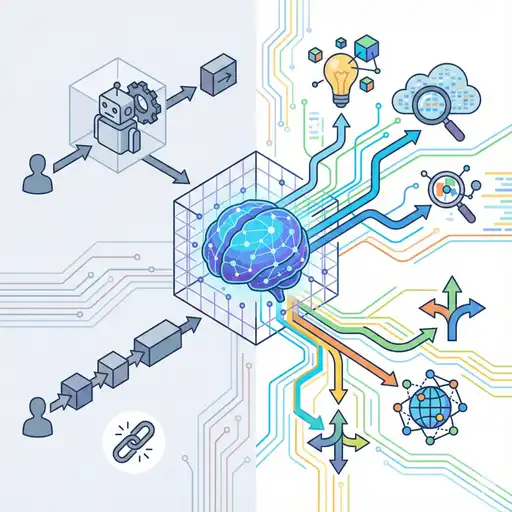
The New Era of Smart Web Browsing

Introduction: The Turning Point Towards a New Era of Information
In an age of information overload, traditional web browsing methods and content publishing practices have long struggled to meet users' ever-growing demand for knowledge and interactive experiences. In 2025, we stand on the threshold of a new era driven by AI and decentralized technologies. In the future, users will no longer need to actively browse websites to obtain information; instead, intelligent browsers will automatically search for, integrate, and analyze relevant structured data to deliver precisely tailored answers. Meanwhile, content creators will no longer be burdened by designing websites or relying on traditional platforms—instead, they simply package their structured data along with identity verification and publish it across decentralized networks. The platform distributes revenue based on views, shares, and clicks, with automated monthly settlements directly credited to users' digital wallets, achieving a dual revolution in both technology and economic models.
1. Intelligent Web Browsing: From Passive Searching to Active Insights
1.1 Intelligent Browsers: Revolutionary Tools for Acquiring Knowledge
Future intelligent browsers will no longer be mere conduits for web links; they will evolve into smart assistants capable of proactively identifying user needs and aggregating information from diverse sources. Leveraging deep learning, natural language processing (NLP), and semantic analysis, these browsers can:
- Proactively Interpret Needs: By utilizing big data models, they swiftly understand users' questions and sift through vast amounts of information to extract the most valuable structured data.
- Construct Knowledge Graphs: In specialized fields such as healthcare, finance, and technology, the system can integrate the latest research reports, statistical data, and expert opinions into a multidimensional network of knowledge, providing users with comprehensive answers in one go.
For example, when querying "latest COVID-19 variants," an intelligent browser wouldn't just return news links—it would directly integrate up-to-date research from authoritative sources, vaccine data, and global pandemic trends to generate an intuitive and highly interactive knowledge graph.
1.2 Personalized Recommendations: From Data-Driven to Need Anticipation
With the integration of user behavior data and AI predictive models, intelligent browsers will evolve from simply suggesting "you might like" to anticipating "what you need right now." This precise content delivery is achieved through:
- Dynamic Content Prioritization: Based on users' browsing history and real-time needs, the system automatically adjusts content rankings, ensuring that information is not only current but also closely aligned with individual interests.
- Multimedia Cross-Integration: Whether it's text, images, or videos, AI can analyze information from multiple dimensions, making the recommended content more immersive. For instance, when a user searches for "green technology," the system will simultaneously provide expert articles, technical lecture videos, and curated expert interview clips.
2. Decentralized Content Creation: Liberating Creators from Constraints
2.1 Structured Data: The New Engine of Content Creation
Traditional web design and content maintenance are cumbersome and require high technical thresholds. In contrast, future decentralized platforms will center around structured data, enabling content to be modular and standardized. The primary advantages of this model include:
- Streamlined Processes: Content creators can focus solely on distilling information and packaging data, without the hassle of web design or backend maintenance. IDC research indicates that using AI tools to manage the content lifecycle can reduce development time by 50%.
- Immutable Identity and Content: Leveraging blockchain technology, every piece of content is accompanied by a unique identity tag and digital fingerprint upon uploading, ensuring the authenticity and immutability of the data source.
2.2 Community-Driven Value Sharing
Decentralized networks (such as IPFS and DAO structures) break the monopoly of traditional platforms, establishing a direct and transparent economic relationship between creators and users:
- Direct Interaction: Creators no longer need to rely on third-party platforms; by uploading their content directly to the blockchain, users can participate in revenue sharing through views, shares, and clicks. Smart contracts operate automatically, eliminating cumbersome intermediaries.
- Transparent Earnings: The platform calculates the traffic value of each piece of data using precise algorithms and regularly credits revenue via stablecoins directly into users' digital wallets. Market surveys indicate that transparent revenue-sharing mechanisms significantly enhance trust between creators and users.
For instance, a tech blogger can simply upload a professionally curated and structured data package to the blockchain, attracting views and interactions from diverse communities worldwide, with every action instantly converting into tangible earnings.
3. Collaborative Economy: From Data Empowerment to Sustainable Development
3.1 Scientific Revenue Sharing: A Data-Driven Earnings Model
The platform employs AI to track real-time metrics—views, shares, and clicks—across various nodes, automatically allocating revenue according to dynamic weighting algorithms. This data-based revenue-sharing model features:
- Automated Settlement: The use of blockchain wallets and stablecoin payment systems eliminates intermediary steps from traditional financial institutions, significantly enhancing both settlement speed and transparency.
- Incentive Mechanisms: User-generated content (UGC) generally sees a 400% higher engagement rate compared to traditional content, demonstrating the powerful monetization potential within a community-driven economy. Data shows that this model fosters the production of higher-quality content, creating a virtuous cycle.
3.2 Sustainable Ecosystem: A Win-Win of Inclusion and Environmental Responsibility
While pursuing technological innovation, the platform also prioritizes environmental sustainability and social responsibility:
- Eco-Friendly Design: By utilizing decentralized storage technology, the system reduces the massive energy consumption associated with traditional centralized servers; moreover, transparent data flows allow companies to authentically showcase their environmental initiatives, earning user trust.
- Inclusive Applications: Integrated AI tools, such as voice navigation and accessibility features, ensure that all users—including those with visual impairments and the elderly—can enjoy the benefits of information accessibility. Research indicates that over 95% of current websites have accessibility issues, and future improvements will yield significant social benefits.
4. Technical Architecture: Robust Security and Flexible Scalability
4.1 Deep Integration of AI and Blockchain
The future platform architecture will be built on the seamless integration of AI and blockchain technologies, ensuring that the system can rapidly analyze vast amounts of data while maintaining impeccable standards of security and trust:
- Semantic Analysis Layer: Drawing on cutting-edge models like ChatGPT, future systems will support cross-lingual and multi-format data parsing, further enhancing the accuracy of content recommendations and integration.
- Secure Record Layer: Blockchain technology not only provides immutable records of content origin but also establishes a tamper-proof, traceable data ecosystem, restoring user confidence in the platform.
4.2 Modular and Microservices Architecture
To handle increasing data traffic and unforeseen events, the platform will adopt microservices and containerization technologies, ensuring high scalability and stability:
- Flexible Scalability: Utilizing container technology, the system can dynamically adjust resource allocation according to varying demands, ensuring stable operation even under high concurrency.
- Real-Time Monitoring: An integrated AI-driven monitoring system can track data flows, user behavior, and potential security threats in real time, enabling prompt responses and strategic adjustments.
Conclusion: Ushering in a New Era of Information Democracy and Value Sharing
This revolution, driven by AI and decentralized technologies, not only redefines how we acquire knowledge and interact but also opens up entirely new possibilities for content creation and revenue sharing. When intelligent browsers become personal knowledge concierges and content creators break free from the constraints of traditional platforms, we will usher in a digital era where "Content is King, and Co-Creation is Shared." Data insights, technological empowerment, and fair revenue distribution—this is not only the blueprint for the future but a reality that is already unfolding. The pioneers who harness this revolution will undoubtedly lead the new wave of information democracy and social progress.
References and Research Sources
- Intelligent Browsing and Knowledge Management: Forrester Report, IDC Research
- Personalized Recommendations and User Engagement: HubSpot Data, Brandwatch Analysis
- Decentralized Technologies and Blockchain Applications: OMG Report, Xiaohongshu Case Studies
- Eco-Friendly and Accessibility Design: WebAIM Report, Oxford University Research
- Technical Architecture and Security Strategies: HelpLook Case Studies, Generative AI Special Report